
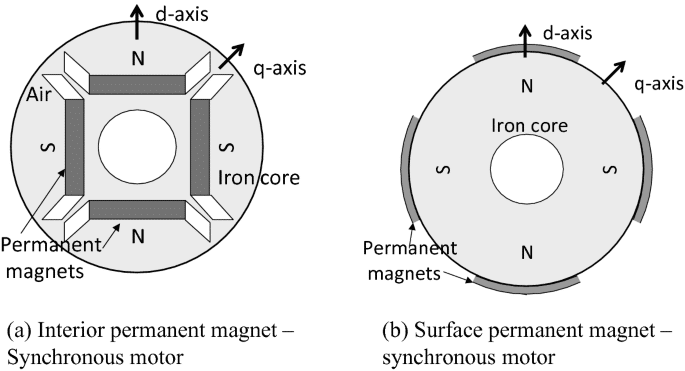
Permanent magnet motors (especially Permanent Magnet Synchronous Motors, PMSM) are widely used in modern industries, home appliances, and other fields due to their high efficiency, high power density, and excellent energy-saving performance. Below is a detailed analysis of their energy-saving performance.
1. Core Principles of High Efficiency and Energy Saving
- No Excitation Loss
- Traditional induction motors require the stator to provide excitation current to generate a magnetic field, resulting in excitation loss (accounting for about 20%-30% of rated power).
- The rotor of permanent magnet motors uses permanent magnets (such as neodymium iron boron) to generate a constant magnetic field, eliminating the need for external excitation and thereby removing rotor copper loss and excitation loss.
- High Power Factor
- Permanent magnet motors can achieve a power factor close to 1 (typically above 0.95) during operation, reducing reactive power consumption and lowering losses in power supply lines and transformers.
- High Efficiency at Low Speeds
- Permanent magnet motors maintain high efficiency even under light loads and low speeds (where induction motors experience a sharp drop in efficiency under light loads).
- They are suitable for variable-frequency speed regulation applications, demonstrating even more significant energy-saving effects under partial load conditions.
2. Energy Efficiency Comparison with Traditional Motors
| Motor Type | Average Efficiency (Full Load) | Light Load Efficiency (50% Load) | Power Factor |
|---|---|---|---|
| Standard Induction Motor (IE2) | 85%-90% | Drops significantly to below 70% | 0.8-0.85 |
| High-Efficiency Induction Motor (IE3) | 90%-93% | 80%-85% | 0.85-0.9 |
| Permanent Magnet Synchronous Motor (PMSM) | 94%-97% | 92%-95% | 0.95-1.0 |
- Energy-saving Data Example:
For a 22kW motor running 4,000 hours per year with an electricity cost of 0.8 RMB/kWh:- Annual electricity consumption of an IE3 induction motor: approximately 78,000 kWh
- Annual electricity consumption of a PMSM: approximately 72,000 kWh
Annual electricity savings: approximately 6,000 kWh, saving about 4,800 RMB in electricity costs.
3. Energy-saving Performance in Application Scenarios
- Variable-Frequency Drive Systems (e.g., pumps, fans)
- When combined with frequency converters, permanent magnet motors achieve energy savings through speed regulation in variable flow/air volume systems, exhibiting 5%-10% higher efficiency than induction motor variable-frequency systems.
- New Energy Vehicle Drives
- Permanent magnet motors have a wide efficiency range, consuming 10%-15% less energy than induction motors under frequent start-stop and variable-speed conditions (such as urban driving).
- Industrial Machinery and Compressors
- In high-load scenarios (e.g., injection molding machines, air compressors), permanent magnet motors can reduce energy consumption by 8%-12%.
- Home Appliances (e.g., air conditioners, washing machines)
- Inverter air conditioners using permanent magnet motors are 30%-40% more energy-efficient than fixed-speed air conditioners.
4. Factors Affecting Energy-saving Performance
- Load Matching: The energy-saving advantage is most significant under long-term medium to light load operating conditions.
- Temperature Effects: High temperatures may cause permanent magnet demagnetization, requiring thermal management systems to maintain performance.
- Cost Considerations: Permanent magnet motors have a higher initial investment (due to reliance on rare earth materials), but the electricity savings from long-term operation can offset the cost difference (typically with a payback period of 1-3 years).
5. Challenges and Improvement Directions
- Rare Earth Dependency: The cost of neodymium iron boron permanent magnet materials fluctuates significantly, and rare-earth-free permanent magnet motors (e.g., ferrite permanent magnets) are a research direction.
- Demagnetization Risk: High temperatures or strong reverse magnetic fields may cause demagnetization, necessitating optimized thermal management and magnetic circuit design.
- High-Speed Field Weakening Control: Field weakening control is required for ultra-high-speed operation, which may increase losses, calling for optimized algorithms.
6. Summary
Permanent magnet motors achieve significant energy savings through three main advantages: eliminating excitation loss, high power factor, and a wide high-efficiency range. They are particularly suitable for variable-frequency speed regulation, intermittent operation, and medium to light load scenarios. In practical applications, energy savings can reach 10%-30%, making them a key choice for industrial energy-saving retrofits and green energy systems. However, selection should consider specific operating conditions, cost recovery periods, and technical compatibility.