
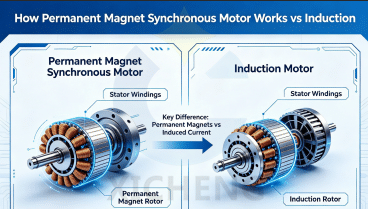
Rotor Field Generation – Magnets vs Induced Current
Permanent magnet rotor creates constant magnetic field without external excitation
In an induction motor, the stator windings create a rotating magnetic field that induces current in the rotor bars. This induced current generates a secondary magnetic field, causing the rotor to turn. However, the rotor speed is always slightly slower than the stator field — a condition called slip — and this slip is essential for torque production. In contrast, a permanent magnet synchronous motor (PMSM) uses high-strength rare earth magnets embedded in the rotor. These magnets provide a constant magnetic field without any electrical input. When AC power is applied to the stator, the rotating field pulls the permanent magnets into perfect synchronization. As a result, the rotor spins at exactly the same speed as the stator field, with zero slip.
Induction rotor requires stator current to induce rotor field (slip effect)
The slip effect in induction motors has real costs. Rotor speed lags behind the synchronous speed by 1–5%, which varies with load. This slip creates rotor copper losses — heat generated by current flowing through the rotor bars — which directly reduce efficiency. Additionally, induction motors have a low power factor (typically below 0.9) because they draw magnetizing current. That current never contributes to mechanical output but still stresses the electrical system and often requires power factor correction equipment in U.S. industrial plants.
Why no excitation current gives PMSM higher power density
Because PMSMs need no excitation current, they eliminate rotor copper losses entirely. Every ampere drawn from the supply goes toward producing torque. This also enables much higher power density: permanent magnet motors are about 35% smaller and 40% lighter than induction motors of the same power rating. For U.S. facilities with space constraints — such as HVAC mechanical rooms or electric vehicle drivetrains — this size reduction lowers installation costs and increases design flexibility. Moreover, PMSMs run cooler, with temperature rises up to 20K lower than comparable induction motors, which extends insulation and bearing life.
Efficiency & Power Factor – What U.S. Plant Managers Need to Know
PMSM maintains >94% efficiency across wide load range; induction peaks at full load
Induction motors achieve peak efficiency (85–92%) only near full rated load. Below 75% load, efficiency falls sharply. In contrast, modern PMSMs consistently achieve 90–97% efficiency across an extremely wide range — from 25% load up to 120% of rated capacity. In variable-speed HVAC applications, for example, a PMSM can be 22% more efficient than a NEMA Premium induction motor at 40% load. For U.S. plants where motors are often oversized and run at partial load, this difference translates directly into thousands of dollars in annual energy savings.
Higher power factor means lower utility penalties for U.S. industrial facilities
Most U.S. utilities impose penalties on customers with power factors below 0.90–0.95. Induction motors typically operate below 0.90, forcing facilities to install expensive capacitor banks for power factor correction. PMSMs achieve power factors above 0.95 — often approaching 0.98 — because the permanent magnets provide the rotor field without drawing reactive current. This higher power factor reduces current draw for the same mechanical output, lowering I²R losses in cables and transformers. Some industrial reports indicate that PMSMs can reduce cable power losses by up to 25%, and in some cases allow the use of smaller gauge cables.
Real-world savings: IE4 PMSM vs IE3 induction under DOE 2027 rules
The U.S. Department of Energy has mandated that motors from 100 to 250 horsepower must meet IE4 efficiency levels by June 1, 2027. A NEMA Super Premium motor (IE4) offers up to 40% lower energy loss compared to IE2 induction motors. For a typical 15 kW motor running 6,000 hours per year at 0.15/kWh,upgradingfromIE3induction(≈90.50.15/kWh,upgradingfromIE3induction(≈90.5883 annually per motor. In a facility with 50 such motors, that exceeds $44,000 per year. Payback periods are typically 9–15 months, followed by 15–20 years of lower electricity bills. For U.S. plant managers planning 2026 capital budgets, specifying IE3 motors for projects that extend past June 2027 creates compliance risk; PMSMs already meet and exceed IE4 today.
Cost, Maintenance & DOE Compliance – Which One Fits Your Application
Higher upfront PMSM cost vs longer lifecycle savings (9–15 month payback)
PMSMs typically cost 15–25% more upfront than induction motors, primarily due to rare earth magnets. For tight capital budgets, this is a real hurdle. However, lifecycle cost analysis tells a different story. For 24/7 production lines, even a 3–5% efficiency gain yields thousands of dollars in annual savings per motor. Payback is usually 9–15 months, after which the savings flow directly to the bottom line for the remaining 15–20 years of motor life. Shifting procurement criteria from initial capex to total cost of ownership is key to justifying PMSM adoption.
Induction motors need regular maintenance; PMSM is virtually maintenance-free
Induction motors require periodic bearing lubrication, cleaning, and winding insulation monitoring. They also generate more heat, which accelerates bearing wear. PMSMs eliminate rotor windings and slip rings, removing several failure points. Because they run cooler, bearing lubricants degrade more slowly and insulation lasts longer. The only unique caution is that rare earth magnets can demagnetize if exposed to excessive heat, but modern PMSMs include thermal protection. Overall, for most U.S. industrial applications, PMSMs deliver lower maintenance frequency and higher reliability.
DOE 2026–2027 standards push IE4 compliance – PMSM ready, induction may need upgrade
On January 14, 2026, the U.S. issued a Section 232 trade proclamation adjusting imports of processed critical minerals to strengthen domestic supply chains. Shortly after, on February 12, 2026, H.R. 7563 (Rare Earth Magnet Market Revitalization Act) was introduced to prohibit imports of certain rare earth magnets from covered nations. These policies signal growing attention to rare earth supply security. For PMSM buyers, this means that suppliers with diversified or domestic sourcing will have a competitive advantage. Meanwhile, DOE’s June 1, 2027 deadline for IE4 compliance on 100–250 HP motors is now less than a year away. PMSMs already meet IE4 and often IE5 levels; older induction motors may require costly upgrades or replacement. Plant managers should factor both efficiency mandates and supply chain policy into their motor specifications today.
Comparison Table: PMSM vs Induction Motor at a Glance
| Feature | Induction Motor | PMSM |
|---|---|---|
| Rotor field source | Induced current | Permanent magnets |
| Slip | Required (1–5%) | Zero |
| Efficiency at full load | 85–92% | 90–97% |
| Efficiency at 40% load | Drops sharply | Remains high |
| Power factor | <0.90 | >0.95 |
| Size/weight for same power | Larger/heavier | ~35% smaller, ~40% lighter |
| Upfront cost | Lower (baseline) | 15–25% higher |
| Payback period | — | 9–15 months |
| Maintenance | Regular lubrication & cleaning | Lower; less heat stress |
| DOE 2027 IE4 compliance | May need upgrade | Already compliant |
Conclusion
Understanding how permanent magnet synchronous motor works vs induction is not just a technical exercise — it is a strategic decision for U.S. industrial buyers. When upfront capex is the only constraint and operating hours are low, induction motors remain a viable choice. But for continuous operation, variable speed, or any application where energy costs matter, PMSMs deliver superior total cost of ownership. With DOE 2027 deadlines approaching and rare earth supply chain policies evolving, PMSMs offer a future-proof solution that meets today’s efficiency mandates while reducing long-term operating expenses. Evaluate your applications by lifecycle cost — not just purchase price — and the right choice becomes clear.